Getting into this box is what's best for both of us. During your time in the box, you will learn so much, and yet experience so little. It's a wild ride, my friend, one well worth the time spent...and let's face it, you don't have much to do these days anyway.

Tuesday, 8 January 2013

The Singaporean Social Campaign Campaign.


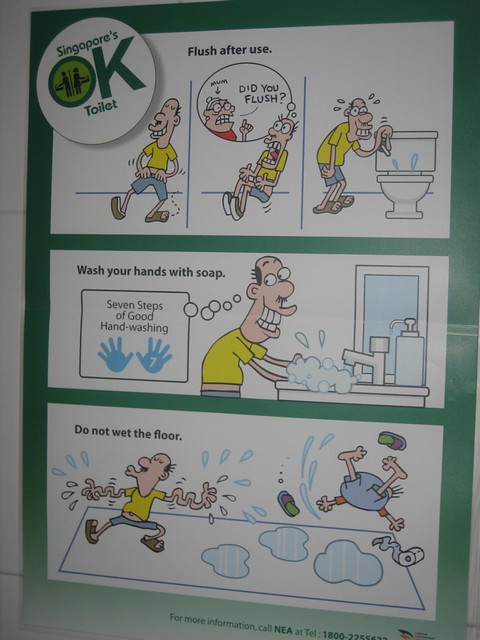
Yes, rest of the world. We Singaporeans are so pathetic our government needs to tell us HOW TO GO TO THE GODDAMN TOILET.

The social campaign has been the go-to social engineering tool for the Singaporean government since it began getting its mucky hands in the business. A grand history of four decades of prodding and poking by people who know better than ourselves what's good for us, and that we should follow their wisdom because damn, did you really imagine we should be allowed to go our own way and make our own mistakes?

I can see where the government is coming from - sometimes. Most of us Singaporeans can be pretty stupid, after all - like everyone else in the world. And yet it says something about both us and the government that even the tiniest things in our lives must be controlled by the state.

But people are blank slates waiting to be written upon! Biology doesn't matter! People don't matter! We can turn anyone into anything we want, so long as the proper pressures are applied, and don't dare to tell us what we can or can't do! Everyone is a cog in a machine that can be replaced by another cog!
This is how you crush a language.

Perhaps the greatest and most successful Singaporean social campaign was the Speak Mandarin Campaign, launched in 1979. Prior to this, the local ethnic Chinese who'd emigrated to South-East Asia spoke the dialect from their locality, and those who spoke the same dialect tended to cluster amongst themselves into their own little communities.

That apparently did not sit well with the government, so they set about convincing us to drop those damned dialects. Why? Well, my private suspicion comes from the fact that most of the old Malay and Indian enclaves were also broken up - not so much by force, but by allocating public housing in accordance with the demographic ratio of the ethnic groups.

Well, it goddamn worked. I'm not too clear on the mechanics, save that government control of the schools and the stopping of teaching of dialects in classrooms had a good part to play in it, but it worked. For some reason, parents were all convinced to stop teaching their kids dialects. Within the short span of thirty-odd years, Chinese dialects have all but been crushed in Singapore. What remains is largely the province of the elderly, clan associations, and the working classes. Hokkien in particular, has come to be associated with gangsterism, an attitude that's prevalent in the armed forces (at least, from my experience in them). No one speaks Chinese dialects in public anymore, while just across the Causeway in Malaysia people are still yattering away in Teochew and Hakka as if nothing had happened.

30 years to crush a whole host of dialects and wipe them from a populace. Less than a generation. Part of the campaign's success was in that we Singaporeans were all so complicit in it and so trusting of authority that we went along with them like sheep to a slaughter...it's interesting how the Singaporean government is defending its mother tongue programmes in schools ("but we need to preserve the culture, and out mother tongues are key to that!") against the very same arguments it used to justify the crushing of the Chinese dialects back in the day.

It's hilarious.

But what it's also led to is the rise of a more cynical and distrusting younger generation that's just a little quicker to do the double-take as opposed to their parents. I remember the general sentiment when I was in school that National Education was "just propoganda", and that everyone was doing it because they had to and just wanted it out of the way as quickly as possible.

 Kids, state-planned economies don't work, what made you think state-planned demographics was a good idea?

When I look at the state of my generation of Singaporeans, we're becoming more and more inured to the constant government exhortations to do this, do that. We've lost that crazy-minded reverence and subservience (at least, inwardly) our parents had for the state, and younger people are starting to grumble in the recesses of Singaporean websites. Sure, the ideas they come up with might be batshit insane (hey, let's have the same level of welfare spending as Norway despite the fact that they have oodles of oil and we don't! That's one thing the government got right, at least - you don't work, you don't eat), but at least they're not taking anything put on the social campaign posters as gospel. Hell, I wonder how many people actually notice the damned things these days, let alone think on the message they carry.

Of course, the response to this is a doubling down on the message. Our government has to teach us how to go to the toilet, how not to spit, how to return our trays at food courts, how to be polite, how to create an inclusive society...

And you see, some people have described Singapore as a benevolent dictatorship. By the looks of the west, you folks there seem to want to follow us in these shoes (especially when it comes to the government telling you what you can and can't do), coupled with a whole lot of welfare spending and debt, which we don't have. Oh, and there's no guarantee that your dictatorship will be benevolent. Our government holds back on using the Internal Security Act for detainment without charge or trial; I wonder if yours will be so reluctant with the NDAA.

We all follow. We all want instruction and comfort. It's easier than taking a risk and thinking for yourself, after all.

I'm just waiting in my box and watching.

My mother.


 "The hand that rocks the cradle is the hand that rules the world."

My mother grew up in a small tin mining village not too far from Ipoh, Malaysia, the fifth of six children. Being born into one of the more well-to-do families in town, (see this previous post for all the details), she might not have been born with a silver spoon in her proverbial mouth, but at least got away with a stainless steel fork.

That didn't stop her from needing to pay her way, though - everyone did in those days. By the time she was ten, my mother would return from the village school during lunchtime to help out. Although she and her siblings were considered lucky by most of the other kids for having a large home and a comfortable living provided for by my grandfather and supplanted by my grandmother, there was still a lot of work to be done in those days; while my aunts and uncles helped my grandmother out in the vegetable fields out back, my mother and youngest aunt would cook lunch for everyone, haul water, and heat up the charcoal irons for ironing her siblings' school uniforms for the next day. I remember her mentioning how my grandfathers' and uncles' pants had to be starched to the point where they could stand up on their own; and to think we have standards now. I've been to my grandmother's house and seen with my own eyes the huge charcoal-fired iron lying dusty and unused in the attic - compared to the modern electric irons of today.

After chores, it was back to the schoolhouse for afternoon lessons (if there were any for the day); if not, my eldest aunt would declare it a wash day, and all four sisters in my grandparents' brood would fill wooden tubs with the family's laundry and head down to the river. Well, not just the river - they had to trek some distance upriver, away from the tin mines, because no one wants to wash their laundry in mining waste, right?

It was a hard life, but everyone's life was hard back then; reality didn't care about quaint little concepts like "being fair". People did what they could and helped each other of their own free will, because it was a small village and people needed each other to get by. But my mother had to learn a whole bunch of skills just to get by - how to sun-dry anchovies and chillies, how to preserve fresh vegetables, how to efficiently prepare food for eight people on a regular basis. Being amongst the youngest, she was spared having to care for her own siblings as young children, but had to learn that later on anyways. My grandmother also insisted on teaching her the basics of tin panning, "just in case", and while it's been a long while since she's last done it, last time I asked her, she was pretty confident she could do it again if need be.

She didn't have to, though. When my mother turned eighteen and was still single due to a lack of eligible young men in the village (two of the most eligible had been snapped up by my aunts), about six of the local girls had gotten job offers from a recruiter looking to hire workers for assembly line positions in factories across the Causeway. My grandfather took time off from his supervisory post at the tin mine to escort my mother and the other girls down to Singapore, made sure they were going where they were going and got the jobs they'd been promised, then returned to the village leaving my mother 500 kilometres from home with a small trunk and a gaggle of young ladies for company.

The next seven years, as my mother put it more elegantly than I'll do, sucked.

The cannery owners were nice enough to provide a dormitory for all the working ladies; it consisted of a tiny room with just enough room to fit a mattress and for one person to stand. (Maybe I inherited my like of enclosed spaces from my mother, too. I already take after her physically, after all. A minor side story - according to my dad, my mother would spend her spare time lying or sitting about in the bedroom when she was pregnant with me, and there was little he could do to coax her out, let alone get out of the house unless absolutely necessary, something that didn't happen with my siblings.) My mother's wardrobe, as she described in great detail (she was trying to impress upon me how lucky we youngsters have it today) was what she could fit on a couple of hooks on the wall.

Six days a week, she'd get up at six in the morning and be on the job in the cannery by seven, which lasted until five with a half-hour lunch break in between. Rows upon rows of ladies in hairnets along the assembly line, in a hot, stuffy environment without the safety regulations of today, canning button and straw mushrooms from dawn to dusk. After work and dinner, it was an hour or so of free time, and then it was off to bed for the next day.

And she did this not so much because of feminism, but because life in those days was crap, the tin mining company was approaching full capacity, and if you didn't work you didn't goddamn eat. Nothing to do with empowerment, finding oneself, or being strong and independent. My mother needed the money, because there weren't men or jobs to be had back home, so she made the decision to strike out on her own. Of course, this was the era before comfy office jobs made their way to this part of the world, and we've never been very big on government largesse, either.

My parents were introduced via mutual friends, and both of them jumped at the chance for each other.

I've looked at my parents' wedding photos. My dad wasn't anything stunning physically - he was in his early 30s and already had a visibly receding hairline - and while my mother still had some looks left, she wasn't exactly beauty contest material. My suspicion is that she understood that at 25, she was already on the crest of the hill and about to take the plunge straight towards the Wall, and settled for my father, who had a stable, well-paying job at one of the local oil refineries. (Singapore doesn't produce any crude, but we sure do refine plenty of it.) She's complained every now and then to the family at large that she's had to cook, clean and wash in the vein of all those traditional feminine duties, but admits it's an easier job than her seven-odd years in the cannery were.

My dad, on the other hand, was (and still is) undisputably delta. Nice, stable guy, not so much aggression or dominance in him, an ectomorph as opposed to my mother's endomorph when it came to body shape. Receding hairline and okay features, enough to look decent in his wedding tux, but nothing to warrant a second glance, I'd wager.

So...yeah. You can see where this is going. Man approaching his peak value, although still not very high, woman realising her value is starting to drop, and both of them settle. The moment they were married, my mother dumped her job at the cannery with glee and eased herself into a life of housewifery.

To this day, she still doesn't like cooking mushroom-based dishes.

Fast forward a little less than a decade, and my siblings and I are born.

Although it's required by Singaporean law that all children be registered for primary school (Well, of course! The government here is so dependent on social engineering and we citizens are all so complicit in it! Technically, it's possible to go and apply for a permit to homeschool your kids, but the government can refuse you for any reason they like and even if you're amongst the six in the nation who do so, they still need to pass "national education" requirements, etc), and I was doing okay in school, she still took it upon herself to tutor me in Chinese - I can't say that I did amazingly well, but by all accounts her efforts resulted in me avoiding the mother tongue abyss that so many Singaporean students fall into. At any rate, it was more successful than her attempts to get me to improve my handwriting, which was a dismal failure despite her trying for eight years of my childhood.

When I look back on things and read about other peoples' accounts of their childhoods out on the net and 'sphere, finding out just how rare simple gestures that I took for granted such as having someone to come home to really are -

I suppose there's some truth in that you can only truly be grateful for what your parents have done for you after you've come into yourself as a person. A child can love his or her parents, but probably doesn't have the ability to grasp the magnitude of what they've done (assuming, of course, normal and stable parents). I'll probably be too embarrassed to say it to her face any time soon, but:

Thanks, mum.

Monday, 7 January 2013

You still have much to learn, grasshopper.


 So I was in the computer lab today with a friend, working on our own project reports, when one of his friends comes in and plops herself down across the desk from us, and a small conversation ensues.

There were so many painfully obvious openings for negs - my friend's remark that her dress looked like a maternity dress, her rueful admission that she'd gained a kilo or two over the last holiday month (now I'm really wondering what might have happened if I'd gone ahead with my remark about it possibly being baby weight. Even if she'd exploded at me, it'd probably have been practice for taking histrionics calmly and aloofly/amusedly. Hah!), and yet I couldn't get the words out of my mouth or replace her with a target dummy in my mind. I guess it didn't help that my friend was the one steering the conversation between the three of us, pulling us into his frame. Since I self-identify as being somewhere along the delta-gamma spectrum (using Vox's system), I guess it's not hard to out-alpha me.

I wonder if he knows about game, or if he's just a natural. I may have to find a way to discreetly ask him.

At least when my friend moved to introduce us properly, I managed to coax her into giving her name first, before I "rewarded" her with mine.

What I think I need to work on now, is confidence when talking to unfamiliar people, men and women alike. Greeting the security guards on campus, asking people the time, asking people at the gym if they're done with the equipment instead of just standing around and hoping they'll get the message. I know it sounds pathetic, but it's an improvement over merely just looking people in the eyes and I think I'm ready for that now. Just walking like I've a sword on my belt makes me feel more confident. I know I can have a loud and commanding voice when the situation calls for it - I was told so, first in basic military training and during my two-year stint in the navy - I just need to exercise it more often.

Baby steps, baby steps. Still have much to learn, much to improve on. Reading Roosh, Heartiste and Vox every day.

Peering out of the box - 7/1/2012.


Cappy Cap - Ferris Bueller syndrome for feminists. Worth a good laugh, aye.

A Voice for Men - Shedding light on Indian misandry. India is a shitty place for everyone, not just women and children. Everyone needs their concerns addressed. Then again, good old divide and conquer, used by governments since time immemorial.

Aurini - Natural law and eternal rebellion.  "No matter how delicious the dinner, the check always comes. And we're a society that is really not prepared to pay the check that is going to be delivered to us."

Sarah's Daughter - The stench of rotting bones. Merely strengthening my resolve to never put any kids I might have into daycare, unlike the tens of thousands of Singaporean parents who let their infants get raised by other people, or god forbid, the state.

Alpha Game - Equality versus the feminine imperative. Equality for me, but not for thee.

Erudite Knight - Trawling OkCupid, and learning to read danger flags.

Hyper Report for 7/1/2012 - Unconstitutional actions.

DEMCAD - Already bad Black unemployment rises.

All right, getting back in my box.

Sunday, 6 January 2013

Manning up - Aurini.


Well, that's all folks. See you in the box.

Inside the box.


 It's common knowledge that the red pill is a bitter pill. The truth will sear your mind, it will weigh heavy on your guts and leave a horrible taste in your mouth.

But at least for those who can handle all that, they will be free. Handling that, though, can be a tricky thing for so many people, and everyone has their own coping mechanism. Some of us manospherians (is that even a word?) have families who're red-pill as well, others have causes they can throw their energies and frustrations into. I suppose even the action of blogging in and of itself is a form of coping with knowing the truth - shouting out to the world and trying to find someone in this sea of madness who will listen.

As M3 points out: "The sphere is poison. So is chemo. And when when you're fighting cancer...all bets are off."

To that end, he unplugged for a couple of weeks and took a break, but now he's back. People suffer from burnout all the time and have to drop out for their own reasons, but as I mentioned in my MGTOW post, the glory of the manosphere is that whenever one falls back, there's always a fresh face filling the empty spot in the ranks. Yet it's all too hard not to stare into the abyss, especially when it hasn't just stared back at you - it's already taken up residence on your couch, monopolised the contents of your fridge and is hogging the remote.

It's imperative you get into this box, our existences depend on it...and I wouldn't lie to me, would I?

To that end, I have the box.

Of course, it should be obvious that the box isn't a physical box I've lugged home and put over my head whenever I feel that the abyss is getting a little too close for my comfort, although I'll say that my room feels that way sometimes. I lived in a converted storeroom from the ages of 6-16, so it's not a big surprise.

Enough about that, though. I was a fantasy novelist - still am writing, although not at the pace that I used to back when I had more free time. And when I go back and look at the stuff I've written over the years and think back on it, it's really true that writing does make you bare your soul to whomever ends up reading your manuscript. Your principles, your beliefs, your desires - even though you might write a character who, say, had a different point of view on a particular issue than you and you had the temerity to not make them stupid or evil like so many authors do, your writing will still be influenced at some level by your views on that opposing viewpoint. It's hard to escape that, unless you're a machine, an AI.

On the other hand, I've found it to be a release of sorts, building a world in my head. Sort of like a thought experiment on "how would you order the world if you were a deity?" only writ large. If you could reshape the world according to your will, how would you go about it? The end product would be a summation of both your conscious and unconscious desires, a world suited to your reality - although not the realities of others. There are two sides to every equation, a zero to every one, as they say. You can't grow as a person unless you accept that your reality doesn't apply to others, and it most likely doesn't match up with objective reality as we red-pillers know it.

But it's nice to retreat into a dream world for a little while and write about worlds where people treat each other with respect and decency, where rulers try to do the right thing, where karma actually exists and things happen for a reason, where human beings and elves and octopus people are actually rational beings who try to work things out and everyone goes home at the end of the day, if not happily ever after.

Well, the alternative is stewing in a cloud of rage and wishing Sodom-and-Gomorrah-esque destruction on all of existence.

***

"You don't seem angry about it."

"Anger would be futile, wouldn't it?"

"Well, yes, but aren't you accustomed to futile anger?"

I felt something like a dry chuckle attempt to escape my throat. I suppressed it and said, "I'm working on that." 

- Phoenix, Steven Brust 

*** 

That's my box. That's where I go when the precipice draws near. And I stay in there, wrap the chains about the wood and click the padlock shut until I'm ready to face the world again, which usually isn't too long. I open the word processor and write, just like when I did after reading this post by dear Glorious Bastard.

Remember to keep a coping mechanism at hand, folks. It's all so easy to spend hours being plugged into the sphere, watching the assembly line of emotions both low and high tick by. Get up from that seat. Spend time with the people you love. Throw yourself into that hobby or sport you have. Do something to prevent yourself from going mad at the world.

The sphere is poison, but there's a Chinese saying: "clear (alternatively, fight) poison with poison". The sphere has to be poisonous in order to have any chance of clearing the rot in our system, or at least die an easier death. No one said the truth was easy.

It's all too easy to let that nilhilistic feeling creep up on you, but as Aurini points out - the flip side of there being no innate meaning means that you can create it for yourself.

So go out and make some meaning, because the alternative's not pretty.

Saturday, 5 January 2013

I don't have anything for you today, so...


Have some music.


Protectors of the Earth is arguably one of the most inspiring pieces of contemporary music I've come across.